
Victoria Smith, Senior Researcher | October 2026
In 2025, ORB International took part in the World Association for Public Opinion Research (WAPOR) inaugural Global Report on Important Topics (GRIT) study, where WAPOR member organizations voluntarily include questions developed by the GRIT committee on a topic of global relevance and pertaining to the United Nations Sustainable Development Goals. Migration was selected to be the focus of the first GRIT report (1). ORB International volunteered to include the GRIT Migration questions in nationally-representative surveys for seven African countries: Chad, Ghana, Kenya, Liberia, Nigeria, Senegal, and Tanzania, fielded between October 2025 and February 2026.
Migration remains a highly topical issue for African countries, but perceptions of migration are usually studied from the perspective of Western countries receiving non-Western migrants, partially due to the sensationalized images of migrants departing for Europe on boats that prevail in media. In reality, the top destination for African migrants is other African states, with most migration occurring intra-regionally (2). Since public opinion plays an important role in shaping immigration policy, it is useful to understand how residents of African countries perceive in-migration.
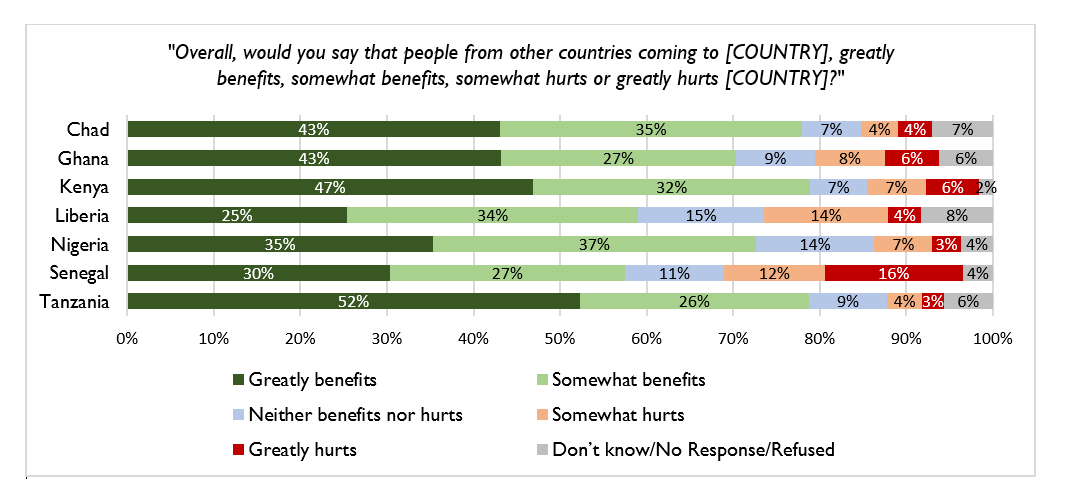
In fact, ORB’s findings from the GRIT study reveal that residents of the sampled African countries generally consider immigration to be beneficial, rather than harmful. A majority of respondents across all seven countries believe that immigration ‘greatly’ or ‘somewhat’ benefits their country. Respondents from Kenya (79%), Tanzania (78%), and Chad (78%) show the most positive views of immigration, while Senegalese respondents show the most negative views: 28% of Senegalese respondents say immigrants hurt their country.
Across countries, respondents identify ‘economic reasons’ as the primary reason that people immigrate to their country. A significant minority of respondents from Tanzania (29%) and Kenya (28%) perceive violence as the main driver of immigration, reflecting both countries’ significant refugee populations from central and eastern Africa.
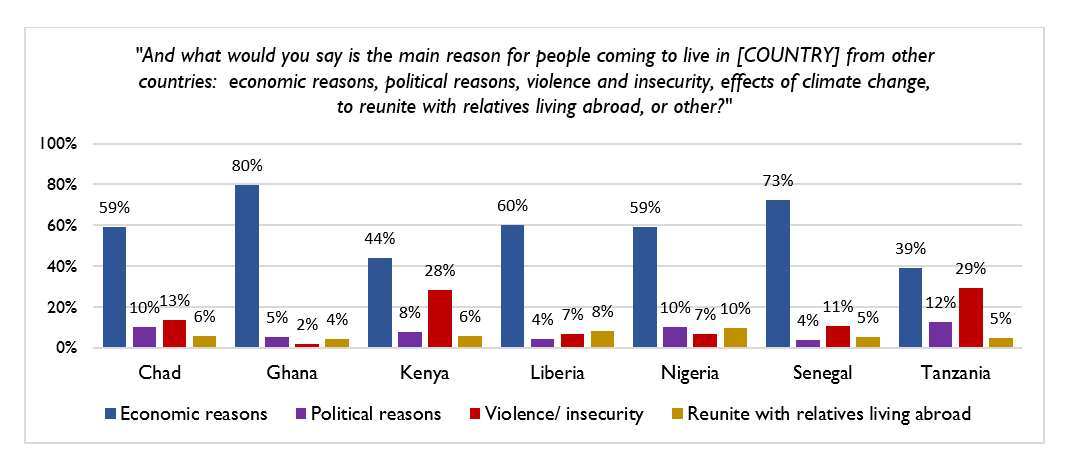
Perhaps the most interesting data point comes from Chad, which has seen an influx of refugees numbering nearly one million since the start of Sudan’s civil war in April 2023 (on top of Chad’s already-existing refugee population). However, only around one-in-ten (13%) of Chadian respondents identify ‘violence/insecurity’ as a reason for immigration to their country. This serves to illustrate a key question when interpreting this data: how do respondents from these seven countries interpret questions about immigration? Are Chadians distinguishing refugees from immigrants? Do members transnational ethnic groups (like the Zaghawa in eastern Chad/western Sudan) consider their family members crossing ill-marked borders immigrants? The nuances of immigration in African contexts make the project of understanding opinions on the topic uniquely challenging.
Despite the difficulty of more granularly interpreting perceptions, it is striking that a majority of participants across the seven countries have positive perceptions of immigration in an era of right-wing backlash against immigrants across the globe. At the regional level, the socio-historical legacy of colonialism and contemporary regional economic integration has likely shaped Africa peoples’ perception of ‘the other’ in a way that avoids the negative policy outcomes for immigrants in other parts of the world; though it should be noted that South Africa, which was not sampled, is an important example of growing anti-immigrant sentiment on the continent. But for now, it seems that immigrants will continue to be welcome in countries across Sub-Saharan Africa, providing an important example of a region where immigrants are viewed as helpful instead of harmful.
(1) WAPOR. (2026). “Global Report on Important Topics 2025 – Migration.” <https://wapor.org/publications/global-report-on-important-topics-grit-report/>
(2) Jelil, Mohamed Abdel; Adhikari, Samik Adhikari, Quy-Toan Do, Heidi Kaila, Federica Marzo, Olive Nsababera, Ganesh Seshan, and Maheshwor Shrestha. (2025). Migration: Africa’s Untapped Potential. Africa Development Forum.<https://documents1.worldbank.org/curated/en/099092425115527214/pdf/P502008-5506f083-90e1-4e33-8709-3ebdd59888b7.pdf>