
Yuliya Dudaronak · Lauren Elreda · Laura Skillin · Alexis Eck · Gabriella Bartlett · George Langhammer
ORB International | September 2026
Artificial intelligence is opening up new ways to add qualitative depth to survey research. One approach ORB International has been testing is AI-moderated interviewing: semi-structured interviews in which an AI moderator asks programmed questions, responds to participants’ answers, and probes for more detail.
Between 2025 and 2026, ORB completed nearly 1000 AI-moderated interviews across studies in Panama, the Philippines, Mexico, and Guatemala, allowing us to test the approach across different languages, recruitment environments, and research topics.
How the capability works
Researchers begin by programming a discussion guide into the AI-moderated interview platform, including the core questions, guidance for follow-up probing direction and depth, and instructions that determine how much freedom the moderator has to adapt. Respondents then access the interview through a link or QR code and complete it on their own time. As they answer, the system transcribes their responses and can ask relevant follow-up questions based on what the respondent has said.
The process is automated, but the research team remains involved throughout. ORB pilots the interview before launch, reviews early transcripts and quality flags during fieldwork, and conducts a final human review before analysis. In practice, the capability combines the scale and flexibility of automated interviewing with researcher control over the questions, probing, and quality standards.
Testing AI moderation across countries
Panama 2025-2026: 308 over two waves of data collection, completed interviews in Spanish, focused on young people’s political influence, foreign partnerships, international competition, and reactions to related content.
Philippines 2025-2026: Three Tagalog-language deployments, with reported completed samples of 59, 100, and 28. Topics included the West Philippine Sea, China, government responses to maritime disputes, and reactions to related content.
Mexico 2026: 201 completed, over three Spanish-language projects examining young men’s emotional support environment and resilience to organized crime groups.
Guatemala 2026: 100 completed Spanish-language interviews examining foreign partnerships, particularly perceptions of the United States and China, alongside content testing.
Together, these projects showed both the potential of AI moderation and the importance of designing the surrounding research process carefully. Here are a few key-takes from these recent experiences:
Recruitment has to fit the local context
Connecting the AI interview to an existing face-to-face survey generally worked well, but the best invitation mechanism differed substantially by country. In the Philippines and Mexico, allowing respondents to scan a QR code during the survey helped overcome concerns about unsolicited links. In Guatemala, respondents distrusted QR codes, and the approach had to be abandoned in favor of phone follow-up and recontact.
One vital consideration when implementing AI-moderated interviews in new locations is technological capability. Since participants require a personal device with both reliable internet connection and audio capture capabilities, local context is important to consider when designing your study. For example, many countries that ORB works in would not be suitable markets due to the lack of internet coverage. Even in the Philippines, a relatively tech savvy country, connectivity posed an issue in some more remote communities.
AI can probe – not just ask questions
One advantage is the ability to respond to what participants actually say. In a Philippines interview, a respondent shifted the conversation from maritime issues toward government corruption. The AI moderator followed up by asking what made corruption and internal government issues more important or urgent to them than military and naval issues.
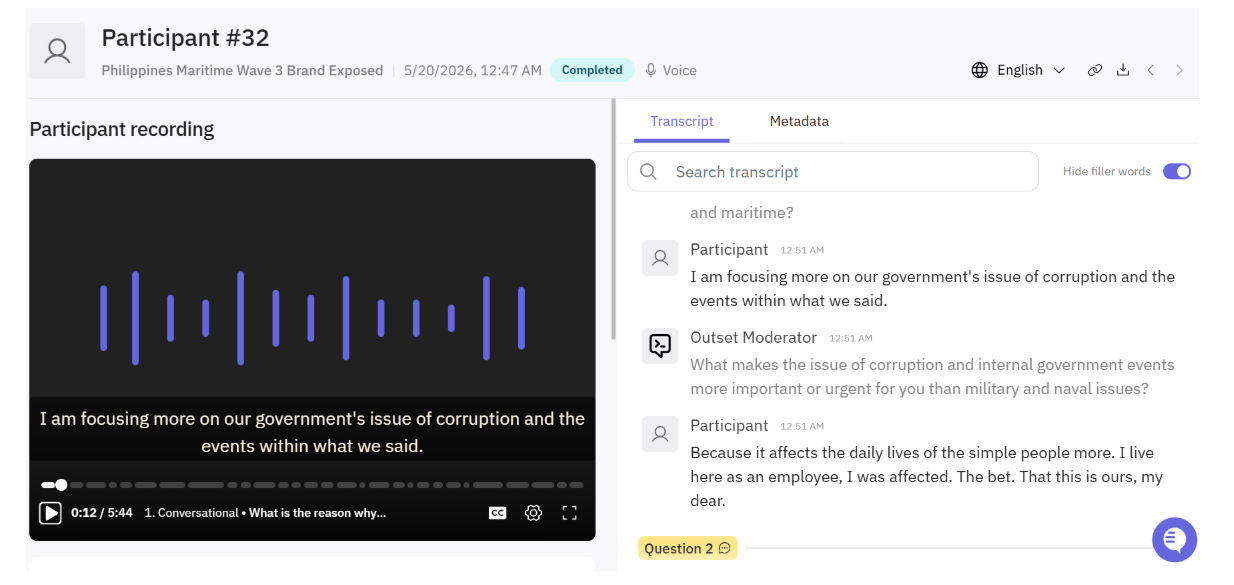
That kind of adaptive questioning can provide richer explanation than a fixed sequence of survey questions. At the same time, the AI needs constraints. In Panama and Mexico 2026, researchers found that some free-form probes moved too far from the intended research question, so the final interview used pre-scripted probes and an “ask verbatim” setting to keep conversations focused.
Many respondents liked the AI experience
In both Guatemala and Panama 2026, 62% of respondents said they would prefer an AI moderator in the future, compared with 38% who preferred a human moderator. Similarly, 51% of Mexico 2026 respondents preferred the AI moderator
Those favoring AI commonly mentioned convenience, privacy, flexibility, and feeling less judged. Respondents who preferred human moderators emphasized empathy, real-time clarification, conversational flow, and the ability to interpret emotion and nonverbal cues. Their own words make the tradeoff especially clear:
“I prefer AI because I feel less pressured and nervous when answering, since there isn’t someone directly judging me, I can express myself more calmly, comfortably, and naturally.” (Panama, Female, 18-25)
“I prefer a human moderator because I feel they can better understand my responses, interpret my emotions, and ask follow-up questions in a more personal and natural way.” (Panama, Female, 26-35)
“I feel that it is more comfortable because one does not depend on a specific schedule and one can do it from anywhere.” (Guatemala, Male, 26-35)
“I feel that a human moderator gives me more confidence to be able to speak and express myself, since it is like more human interaction.” (Guatemala, Female, 26-35)
These sentiments were echoed in the Philippines and Mexico:
“I still prefer human moderation. To be more specific, it’s not exactly the same… but I also like AI because it doesn’t have any biases. Whatever you say, it just listens, unlike a human. With a human, it’s more like they’ll steer you toward a certain question or something?” (Philippines, Female, 33-40)
“For me, it’s okay either way. It’s okay if it’s a person or if it’s AI. They’re kind of the same. But I feel like the AI is better for me because you can say… whatever you want to say.” (Philippines, Female, 18-24)
“I feel it’s better to be talking face-to-face with someone you can explain things to and who can understand you better, because here I feel like they don’t get the idea.” (Mexico, Male 18-25)
“Well, the moment an interviewer is physically with you, you see their reaction when you’re addressing a particular topic. There is nothing like seeing him face to face, seeing his reaction, seeing one’s own or seeing if he cries, one becomes sad, becomes happy, and avoids the gaze. There are many, many factors which I would prefer a person physically than a machine.” (Mexico, Female, 31-45)
Together, these responses suggest that AI can reduce some forms of social pressure and make participation more convenient, while human moderators retain an advantage when respondents value empathy, reassurance, and more natural conversational exchange.
Survey responses can shape more targeted qual follow-up
AI-moderated interviews can also add analytic value as part of an iterative research process. By recruiting a subset of survey respondents for follow-up interviews, researchers can explore the “why” and “how” behind their survey answers, and hear how people describe the same topics in their own words when questions are more open-ended. Linking the two sources helps researchers interpret survey patterns, explore possible explanations, and identify nuances that fixed response options may miss.
Survey responses can also inform who is invited and which questions they receive. In one ORB project, respondents were routed to different discussion guides based on whether they reported exposure to particular campaign content or not. This allowed us to tailor the follow-up without drawing attention to the specific answers that determined their interview assignment, helping reduce the risk of those cues shaping their responses. The same approach could be used to explore contrasting audience profiles: for example, people expressing high or low support for a particular policy or topic. Researchers can then tailor questions to each group, or use a common guide and compare responses by survey-defined profile, building a clearer understanding of the reasoning and experiences behind different views.
Conclusion
Our experience suggests that AI-moderated interviewing can make qualitative follow-up faster and more scalable, but it is not a “set and forget” technology.
Researchers still need to design and test probes, review early transcripts, monitor disengagement and fraud, check translations, and decide which interviews are suitable for analysis. This was particularly important in the Philippines, where Tagalog-to-English translation required additional quality review.
For ORB, the opportunity is not to replace human qualitative research. It is to identify where AI can extend the reach of qualitative methods while researchers retain control over design, quality, and interpretation.