
Transforming data into action for our local community
This July, ORB’s U.S. office once again partnered with the Blue Ridge Area Coalition for the Homeless (BRACH) for Charlottesville’s 2026 Point-in-Time (PIT) Count, including the community’s first-ever Summer Point-in-Time Count.
The Point-in-Time Count is the only federally mandated annual count of people experiencing homelessness in the United States. Conducted by local Continuums of Care with the help of community volunteers, the count provides a snapshot of homelessness on a single night and helps communities understand local needs, identify service gaps, and inform planning and funding decisions for housing and support services.
While communities nationwide traditionally conduct the count in January, BRACH received funding from the City of Charlottesville to conduct an additional summer count this year. The summer count provides an additional seasonal snapshot of people experiencing unsheltered homelessness and can help local leaders better understand how needs may differ throughout the year.
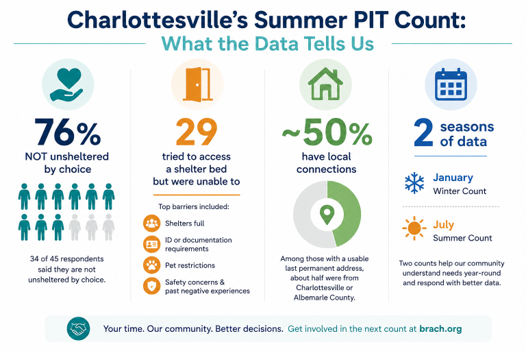
Note: Graphic reflects unsheltered respondents surveyed by ORB; people staying in shelters are counted separately by shelter providers.
The findings below are based on interviews with people experiencing unsheltered homelessness who were surveyed during the Summer PIT Count. Information about people staying in shelters is collected separately by shelter providers, so these survey findings represent the unsheltered respondents reached during fieldwork rather than the full population of people experiencing homelessness in Charlottesville.
This year’s results also provide insight into two topics that are often part of the local conversation around homelessness: the previous permanent residences reported by unsheltered respondents and why some remain unsheltered.
Among respondents who provided a usable last permanent address, approximately half reported a last permanent address in Charlottesville or Albemarle County. Additional respondents reported previous addresses elsewhere in Central Virginia, while a smaller number reported locations outside Virginia. These findings provide important local context for conversations about the ties unsheltered respondents have to the area.
The results also illustrate the barriers people can face when trying to access shelter. Among respondents who answered the question, 76% said they were not unsheltered by choice. In addition, 29 respondents reported that they had tried to access a shelter bed but were unable to do so.
Respondents cited a range of barriers, including shelters being at capacity, identification requirements, substance-testing policies, restrictions involving pets, application challenges, safety concerns, and previous negative experiences with shelters.
These findings demonstrate why local data collection matters. Understanding not only how many people are experiencing homelessness, but also their circumstances and barriers to shelter, gives BRACH and local leaders evidence they can use to better understand community needs and inform future services and resources.
ORB’s involvement in the PIT Count begins before volunteers enter the field. Each year, ORB develops and programs the survey used during the count, hosting it on the SurveyToGo mobile data collection platform. Our team scripts and tests the questionnaire, updates locations and survey logic as needed, and ensures the instrument is ready for data collection.
Before fieldwork begins, ORB also provides training on both the questionnaire and SurveyToGo. Many participants are community volunteers who may have little or no previous survey research experience, so ORB staff walk volunteers through the questionnaire, interview techniques, and technology they will use in the field.
On July 22 and July 23, ORB staff worked alongside community volunteers to interview people experiencing unsheltered homelessness across Charlottesville. Throughout data collection, our team remained available to troubleshoot technical issues, monitor incoming data, and ensure interviews were successfully recorded.
Once fieldwork is complete, ORB cleans and validates the dataset, produces summary statistics, and delivers the final data to BRACH. The findings help BRACH better understand the experiences and characteristics of the unsheltered people reached during the count, identify barriers to accessing shelter, and assess where additional services may be needed. The information can also support grant applications, funding requests, and local policy and program decisions.

Photo 2: Downtown Charlottesville at sunset
For ORB, the PIT Count is a natural extension of the work we do every day. Around the world, we help governments, nonprofits, and international organizations collect reliable evidence to better understand complex social challenges. Working with BRACH gives us an opportunity to apply those same research skills here at home while contributing to a stronger understanding of homelessness in our local community.
The PIT Count is made possible by community volunteers who help conduct interviews and collect this important information. Those interested in participating in a future Charlottesville-area PIT Count can follow BRACH for information about upcoming volunteer opportunities.
We’re proud to continue working with BRACH and the Charlottesville community and grateful to the volunteers and organizations that made the inaugural Summer Point-in-Time Count possible.