
By Glennie Webster
The impact of artificial intelligence has rippled across several industries, including research and analysis. AI’s ability to rapidly process diverse sources and generate insights around the clock has made research faster and more accessible, despite its limitations in capturing nuance and context without human input.
Introducing wAIve™: AI-Powered Global Radio Monitoring
ORB has developed a new tool harnessing the power of AI to enhance our global Media Monitoring capability. The product, named wAIve, is unique in its data input: near real-time terrestrial FM and Digital radio monitoring across 12 countries, with set-up possible in nearly any location worldwide. wAIve transcribes, translates and classifies large volumes of unstructured radio broadcasts with AI-powered speech recognition and natural language processing across more than 140 languages. Processed qualitative data is fed into a customizable, secure dashboard for manipulation, analysis, visualization and export.
Why radio still matters
Radio remains dominant in contested or low-connectivity environments, including Africa and conflict-affected zones around the globe. Usage is high in Nigeria, for instance, with 77% of the population using radio once a week or more, according to ORB International’s public polling data from November-December 2024 (see other countries in the table below). Similar patterns hold in rural, infrastructure-poor, and conflict-impacted contexts.
Radio’s relevance is particularly acute in regions characterized by:
- Large rural populations
- Limited or unreliable internet penetration
- Conflict- or environment-related infrastructure damage
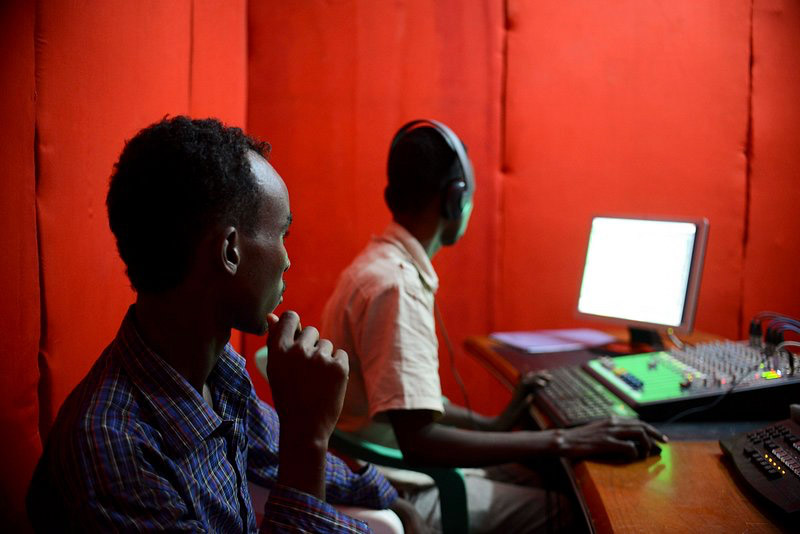
Figure 1. Somali radio broadcasters
Yemen, a recent addition to wAIve’s roster, exemplifies these conditions. With chronic electricity shortages, uneven connectivity, and ongoing conflict dynamics, radio remains a primary media source for many local communities. Yet despite its reach and influence, it is frequently underweighted in media and information environment assessments.
| Country | Fieldwork dates | Percentage of respondents using radio “once a week or more” |
| Nigeria | Nov-Dec-24 | 77% |
| Kenya | Oct-Nov-25 | 62% |
| Burkina Faso | Jul-Aug 23 | 60% |
| Mali | Feb-25 | 58% |
| Ghana | Nov-Dec-25 | 55% |
| Benin | Jun-Jul-25 | 53% |
| Tanzania | Oct-Nov-25 | 51% |
| Sudan | Dec-24-Mar-25 | 50% |
| Niger | Jul-23 | 47% |
| Senegal | Jun-Jul-25 | 44% |
| Somalia (South central) | Jun-Aug-25 | 44% |
| Libya | Jun-25 | 40% |
| Chad | Jun-25 | 37% |
| Tunisia | May-25 | 35% |
| Côte d’Ivoire | Jan-Feb-26 | 21% |
Figure 2. ORB Polling, N= 711-1303
In times of crisis, where internet access is disrupted or deliberately shut down by the government, populations often turn to radio for vital reporting and trusted information. This was evident most recently in Iran in January 2026, when government-imposed internet restrictions heightened reliance on broadcast media. In these moments, it becomes more critical than ever to monitor radio broadcasts for real-time monitoring of news, narratives, and on-the-ground developments.
High-value radio broadcasts isolated and captured by wAIve are critical for:
- Communication planning
- Campaign monitoring
- Crisis response
- Narrative assessment
Case study: Monitoring Al-Shabaab communications tactics in Somalia
In Somalia, wAIve’s monitoring of radio outputs in South Central led to the identification of new trends in communication strategies by the Islamist armed group Al-Shabaab.
Through our Somali monitoring, wAIve picked up sustained radio coverage concerning housing demolitions in Mogadishu’s Daynile district between August 1 and October 16, 2025. These demolitions were allegedly backed by Somali President Hassan Sheikh Mohamud’s administration who had orchestrated indiscriminate seizures of property through forced evictions. This generated significant public outcry and protests across radio stations broadcasting in the Mogadishu area.
In September, 2025, the Radio Shabelle evening news program broadcasted a statement from a spokesperson for Al-Shabaab who accused “business people, politicians, and the President of Somalia” of destroying poor families’ homes “to benefit certain individuals,” warning that those involved “will face consequences in the coming days from the mujahideen.”
According to ORB’s longitudinal analysis, this exemplifies a rare instance where a popular Somali radio station directly amplified a statement from an Al-Shabaab spokesperson. Even more, ORB analysts recognized that Al-Shabaab was reactionary in their communication, using a radio broadcast of its spokesman on Somali airwaves to exploit public anger over the Daynile land evictions and push its anti-government narrative through mainstream media.
This is a clear example of using wAIve data to establish abnormalities in communications tactics, a scenario which could apply itself to the humanitarian sector in addition to conflict-based research.

Figure 3. wAIve groups radio transcripts into clips that isolate single issues or related topics. Each clip is interactive, users can play the audio, read the full transcript, and view a self-updating AI-generated report.
The future of AI in media monitoring research
As the research industry looks to carefully integrate AI into its research protocols, as a research capability, wAIve is cutting edge: Harnessing AI-powered speech recognition and analyst expertise, to incorporate analysis of FM radio into assessments of the information environment, despite radio so often being overlooked.
wAIve successfully balances the value of human analytical input alongside the limitations of AI-backed assessments. By retaining analyst oversight, wAIve ensures that context, nuance, and critical judgment are not lost, while also making data processing more efficient. This balance positions researchers well to incorporate AI into their work without compromising high-quality analysis.
If you would like to hear more about wAIve, please reach out to gwebster@orb-international.com or TEAM-ORB-wAIve@orb-international.com